Your cart is currently empty!

End of Year survey 2024
Survey conducted during March 2025, published April 10th 2025
Control Group Cooperative Ltd.
Introduction
The aim of this survey was to find out how Control Group participants felt their overall health was in 2024, to understand how their attitudes to allopathic medicine may have changed after the COVID pandemic era, their health goals moving forward and the challenges they feel they face.
The questions were:
- During 2024, was your health mostly: Excellent, Good, Fair, Poor, or Very poor?
- How has your attitude towards conventional / allopathic medicine changed since 2020?
- What is your overall perspective on life, health and well-being going into 2025?
- What is the main reason you feel this way?
- What do you currently consider the biggest challenge to your health?
- What is your most important health or wellness goal for 2025?
- Do you feel the pandemic era has caused you to take a more active role in your health?
- Confirm your COVID vaccination status
- Confirm your Childhood vaccination status
How was the survey conducted?
The online survey was time-limited from 1st March 2025 to 31st March 2025, and open to all existing Control Group (CG) participants over the age of 18 years. Respondents had to login to their CG account to access the survey, which was self-reported, with nine questions, being a mix of multiple-choice questions and free-text entries.
3882 people took part, with 485 under the age of 40 (12%) and the 3397 (88%) over the age of 40.
Limitations
Almost all the respondents are COVID unvaccinated (approx. 98%) with most of these people already being health-aware and suspicious of mainstream medicine (by virtue of being a member of the Control Group) and therefore any change shown in attitude toward allopathic medicine is likely to be different to the general population.
Most of the participants are in the over 40 age range, so there is not an even spread across adult age-brackets.
Q8. Please confirm your COVID vaccination status
Responses
Unvaccinated = 3811 (98.16%), Vaccinated = 71 (1.83%)
Q9. Please confirm your Childhood vaccination status
Responses
I had some or all childhood vaccines = 3655 (94.15%), I have never had any childhood vaccines = 227 (5.85%)
Q1. During 2024, was your health mostly: Excellent, Good, Fair, Poor, or Very poor?
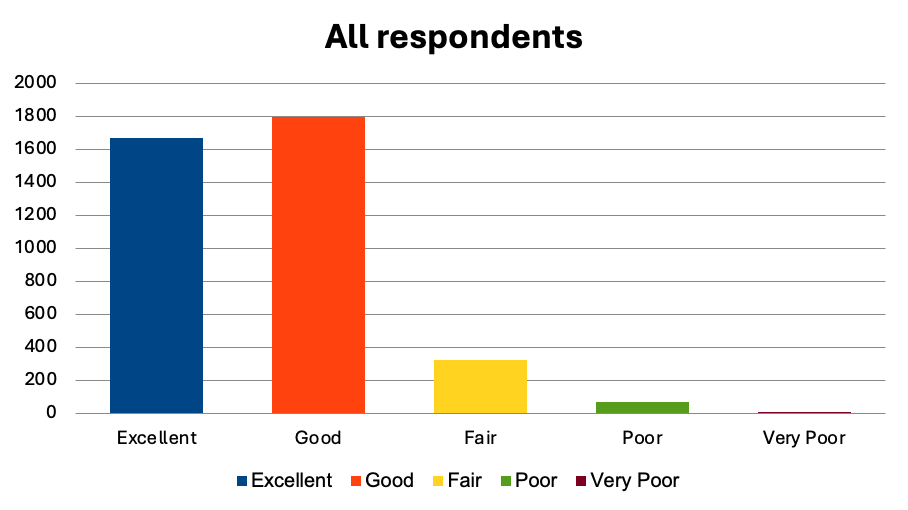
The majority of respondents reported having a positive perception of their health in 2024, with 42.97% rating it as “Excellent” and 46.37% rating it as “Good.”
A smaller portion of respondents (8.37%) described their health as “Fair,” indicating some challenges but not severe issues. Meanwhile, only a very small minority reported struggling significantly with their health, with 1.93% rating it as “Poor” and just 0.36% as “Very Poor.”
Overall, these responses reflect a generally optimistic view of personal health in 2024, with most individuals feeling they were in good or excellent condition. However, a small portion of the population still faced notable health struggles.
Responses (all respondents)
Excellent = 42.97%, Good = 46.37%, Fair = 8.37%, Poor = 1.93%, Very poor = 0.36%
Age range of respondents
The age demographic of Control Group survey respondents was mostly in older, with 88% of survey respondents over the age of 40, and of those, 81% being 50 and over, and with 23% of those being aged 70 and over.
According to a study by ICL (https://www.bbc.co.uk/news/health-57982476), 34% of 46 to 48 year-olds have 1 or more chronic health condition, and approximately 28% of people aged 50 and over in England self-reported that they were not in good health (https://ageing-better.org.uk/health-and-wellbeing-state-ageing-2023-4).
89.34% of our respondents reported being in Good or Excellent health in 2024, with only 2.29% reporting Poor or Very poor.
Comparing responses for COVID Vaccinated / Unvaccinated
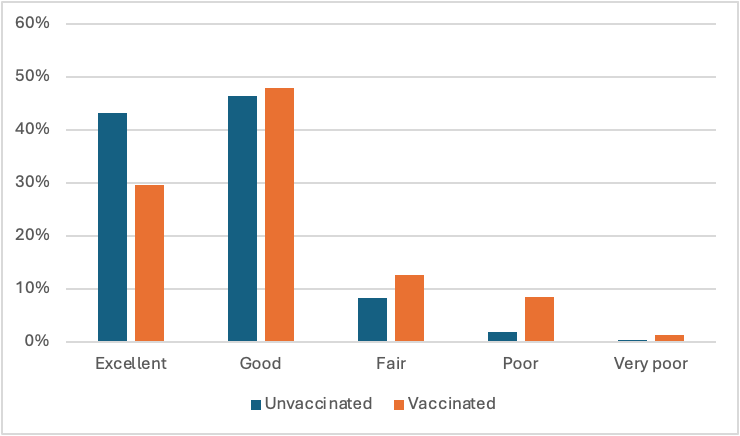
Please note that the low numbers of COVID vaccinated respondents may not be truly representative of the wider COVID vaccinated population.
Q2. How has your attitude towards conventional / allopathic medicine changed since 2020?
Responses
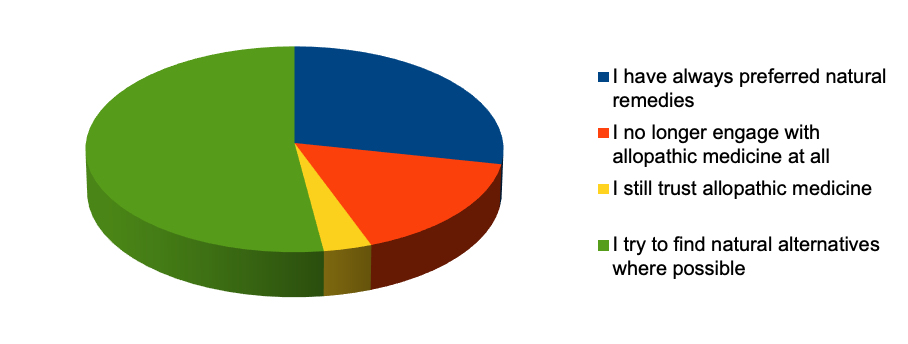
I have always preferred natural remedies = 28.28%
I no longer engage with allopathic medicine at all = 16.07%
I still trust allopathic medicine = 3.53%
I try to find natural alternatives where possible = 52.11%
The responses indicate a strong shift away from conventional (allopathic) medicine, with a majority (52.11%) stating they try to find natural alternatives whenever possible. Additionally, 16.07% have completely disengaged from allopathic medicine, suggesting a significant level of distrust or dissatisfaction.
A substantial portion (28.28%) have always preferred natural remedies, indicating that a reliance on alternative medicine is not a new trend for many respondents but rather a long-standing preference.
In contrast, only 3.53% still trust allopathic medicine, highlighting a considerable decline in confidence in mainstream healthcare systems.
Overall, these results suggest that since 2020, there has been a growing scepticism toward conventional medicine, with most respondents actively seeking or prioritising natural health solutions over pharmaceutical or doctor-led interventions.
RESPONSES BY REGION
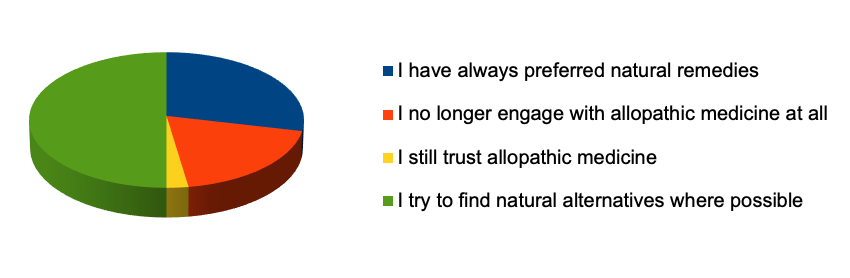
United Kingdom
I have always preferred natural remedies = 28.57%
I no longer engage with allopathic medicine at all = 19.02%
I still trust allopathic medicine = 2.41%
I try to find natural alternatives where possible = 50.00%
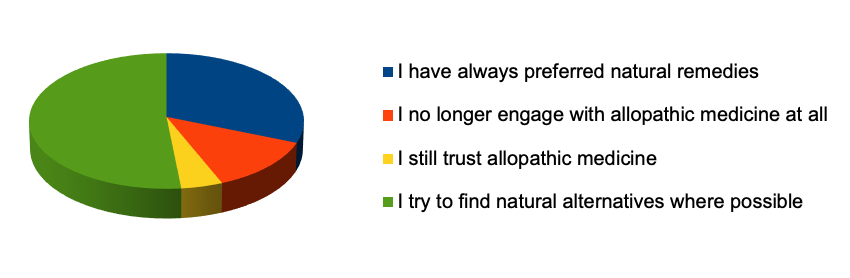
Europe (without UK)
I have always preferred natural remedies = 31.12%
I no longer engage with allopathic medicine at all = 12.63%
I still trust allopathic medicine = 4.62%
I try to find natural alternatives where possible = 51.62%
Australia
I have always preferred natural remedies = 25.92%
I no longer engage with allopathic medicine at all = 18.03%
I still trust allopathic medicine = 4.00%
I try to find natural alternatives where possible = 52.05%

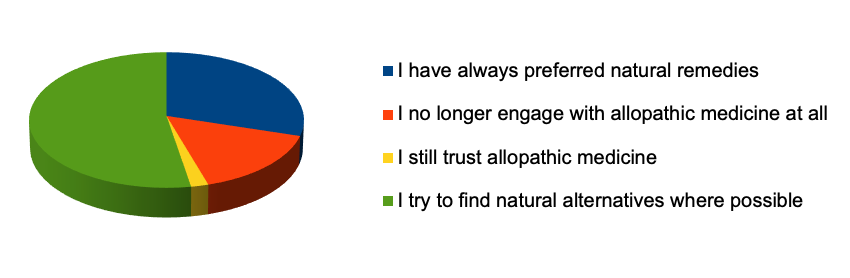
Canada
I have always preferred natural remedies = 29.73%
I no longer engage with allopathic medicine at all = 15.64%
I still trust allopathic medicine = 1.93%
I try to find natural alternatives where possible = 52.70%
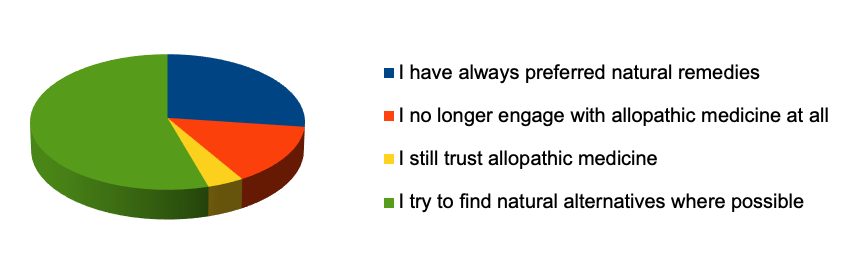
North America
I have always preferred natural remedies = 27.09%
I no longer engage with allopathic medicine at all = 14.29%
I still trust allopathic medicine = 4.08%
I try to find natural alternatives where possible = 54.55%
South America
I have always preferred natural remedies = 25.23%
I no longer engage with allopathic medicine at all = 10.81%
I still trust allopathic medicine = 5.41%
I try to find natural alternatives where possible = 58.56%
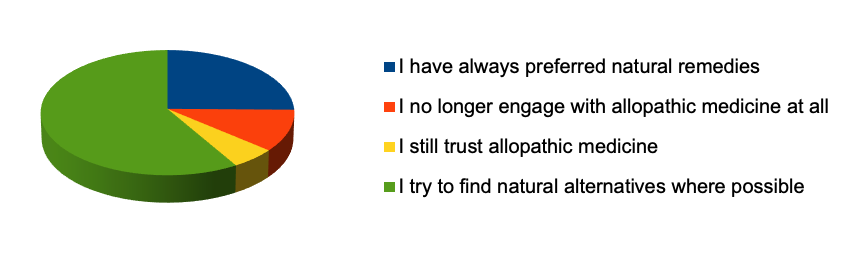
Africa
I have always preferred natural remedies = 33.33%
I no longer engage with allopathic medicine at all = 8.89%
I still trust allopathic medicine = 4.44%
I try to find natural alternatives where possible = 53.33%
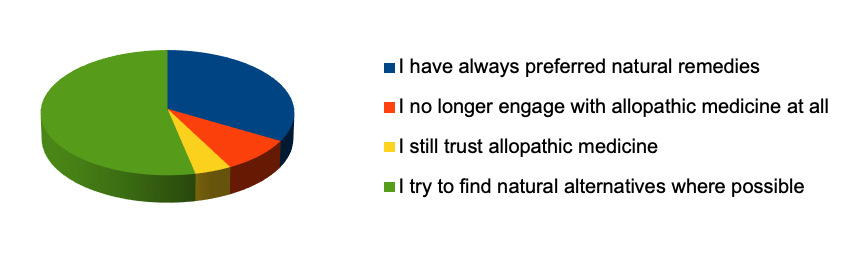
Asia
I have always preferred natural remedies = 29.31%
I no longer engage with allopathic medicine at all = 6.9%
I still trust allopathic medicine = 8.62%
I try to find natural alternatives where possible = 55.17%
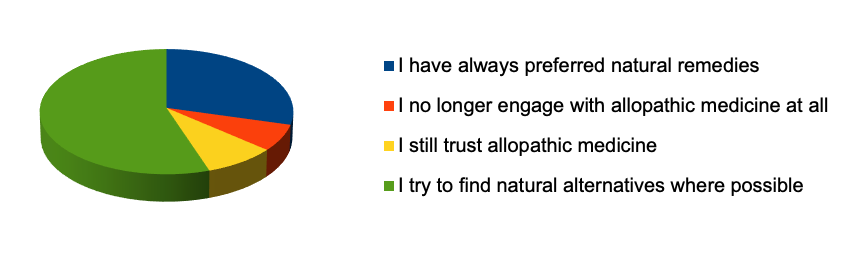
Q3) What is your overall perspective on life, health and well-being going into 2025?
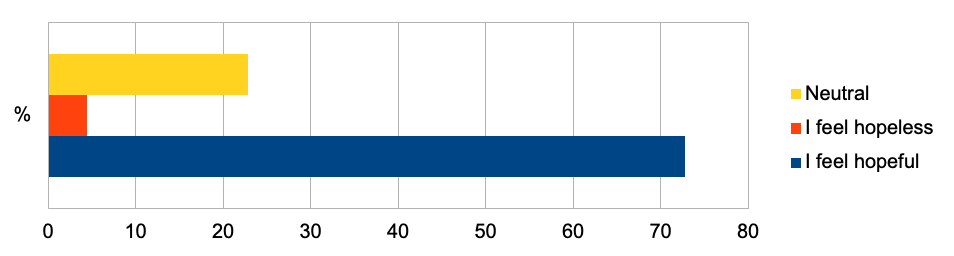
The majority of respondents (72.8%) feel hopeful about life, health, and well-being as they move into 2025. This indicates a largely optimistic outlook, with most people confident about their personal and overall well-being.
A smaller portion (22.77%) hold a neutral stance, suggesting they may feel uncertain or indifferent about what the future holds.
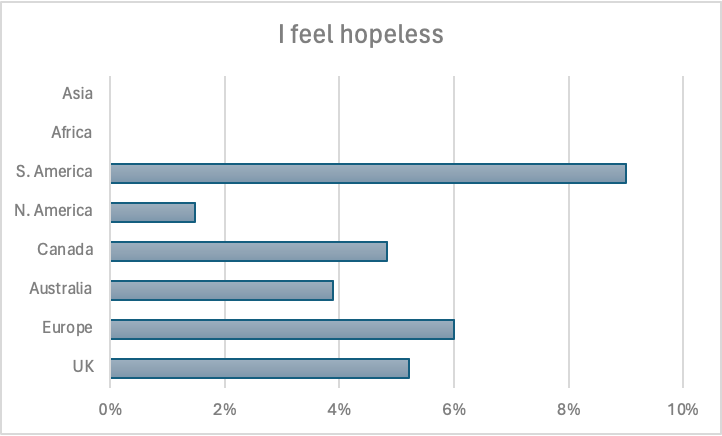
Meanwhile, only 4.43% of respondents expressed hopelessness, indicating that while some individuals are struggling with concerns about the future, they represent a small minority.
Overall, these results reflect a strong sense of optimism for 2025, with most individuals maintaining a positive mindset about their health and well-being.
Responses
I feel hopeful = 72.80%
I feel hopeless = 4.43%
Neutral = 22.77%
RESPONSES BY REGION
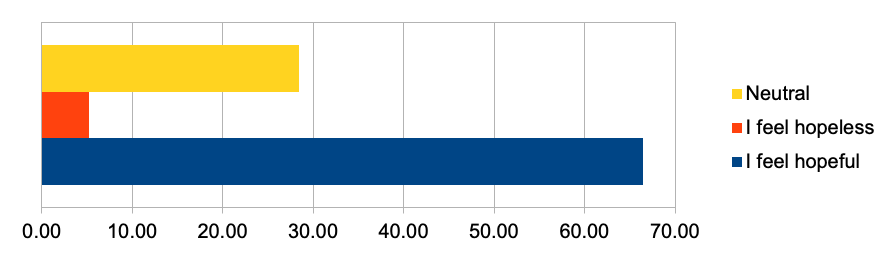
UK
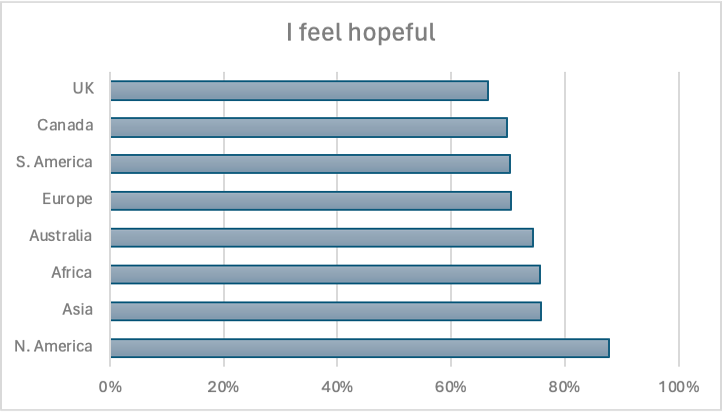
I feel hopeful = 66.41%
I feel hopeless = 5.21%
Neutral = 28.38%
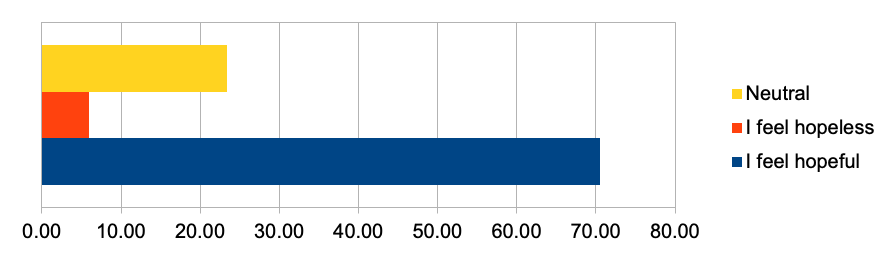
Europe
I feel hopeful = 70.57%
I feel hopeless = 6.01%
Neutral = 23.42%
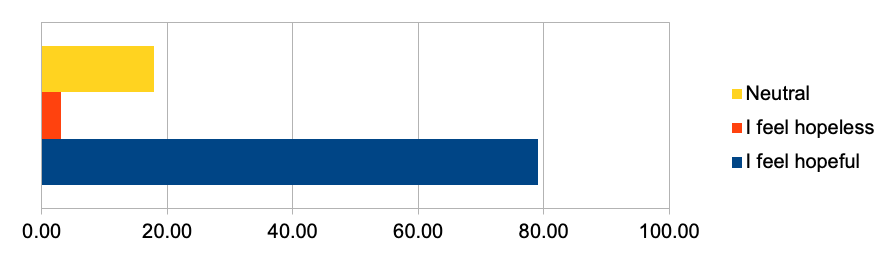
North America
I feel hopeful = 79.00%
I feel hopeless = 3.12%
Neutral = 17.88%
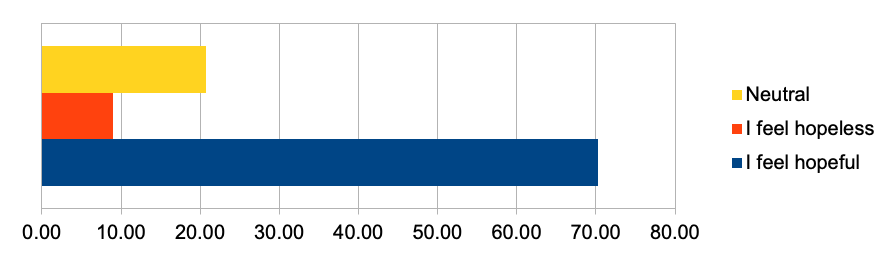
South America
I feel hopeful = 70.27%
I feel hopeless = 9.01%
Neutral = 20.72%
Africa
I feel hopeful = 75.56%
I feel hopeless = 0.00%
Neutral = 24.44%

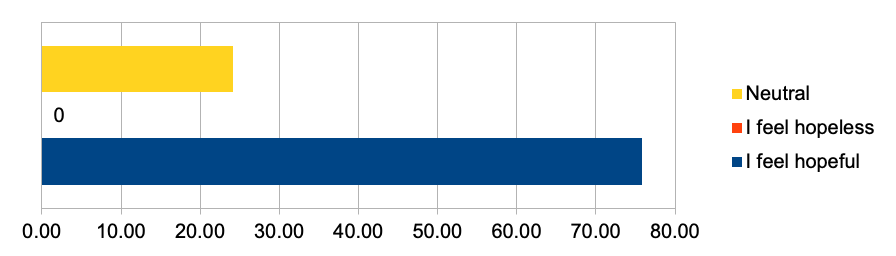
Asia
I feel hopeful = 75.86%
I feel hopeless = 0.00%
Neutral = 24.14%
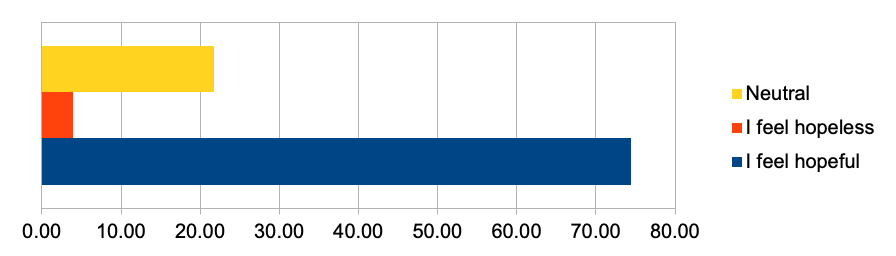
Australia
I feel hopeful = 74.41%
I feel hopeless = 3.89%
Neutral = 21.71%
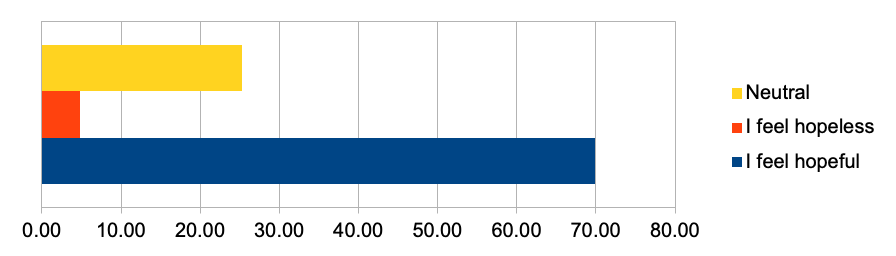
Canada
I feel hopeful = 69.88%
I feel hopeless = 4.83%
Neutral = 25.29%
ALL COUNTRIES COMPARISON (excluding ‘Neutral’ responses)
Q4) What is the main reason you feel this way?
Expanding upon Q3: What is your overall perspective on life, health and well-being going into 2025? These were free-text responses.
From the individuals who responded with “I feel hopeful” several key themes emerged:
- Personal Agency and Control – Many respondents express hopefulness due to their ability to take control of their health, well-being, and lifestyle choices. They emphasize maintaining good habits such as eating well, exercising, and managing stress effectively.
- Positive Mindset – A significant number of responses indicate that an optimistic and grateful outlook plays a crucial role in their hopefulness. Some individuals explicitly mention being naturally positive, always trying to maintain an optimistic view, or being “free thinkers.”
- Strong Support Systems – Many people derive hope from their relationships with family, spouses, children, and grandchildren. The presence of loved ones and a strong social network contributes to their sense of well-being and security.
- Holistic and Preventative Health Approaches – Some respondents mention being well-informed about health or actively practising holistic approaches to well-being, such as functional health coaching or self-care without reliance on traditional medical establishments.
- Gratitude for Good Health – Many individuals express gratitude for being healthy and physically capable, which reinforces their hopeful perspective.
- Knowledge and Awareness – A few responses point to knowledge and awareness as sources of confidence, suggesting that staying informed about health and well-being contributes to a sense of empowerment.
Overall Sentiment – “I feel hopeful”
The predominant sentiment in these responses is one of confidence, gratitude, and optimism. Those who feel hopeful generally believe that they have control over their circumstances, are proactive in maintaining their health, and appreciate the good things in their lives. Many focus on their personal efforts and mindset rather than external factors.
For the individuals that answered “I feel hopeless” to the previous question, below is a summary of key themes and sentiments expressed:
Political and Government-Related Concerns
- Distrust in government leadership and policies, particularly in relation to global organizations like the WEF (World Economic Forum) and WHO (World Health Organization).
- Fear of increasing government control, including concerns about authoritarianism, communism, and globalism.
- Worries about election outcomes in countries like the US, UK, and Canada, with some anticipating worsening conditions.
- Immigration policies causing anxiety about national identity and security.Belief that leaders are not prioritizing citizens’ well-being.
Economic Struggles and Cost of Living
- Rising inflation, cost of living, and economic instability creating financial hardship.
- Specific concerns about Canada’s economic situation, trade tensions, and international interference in politics.
- Worries about money laundering, job security, and fin
Health and Medical System Issues
- Distrust in pharmaceutical companies (“Big Pharma”) and concerns about vaccine ingredients.
- Frustration over the lack of alternative medicine specialists and access to non-mainstream treatments.
- Issues with chronic illness, delayed diagnoses, and ineffective healthcare systems.
- Mental health struggles, including severe anxiety, PTSD, and conditions causing physical suffering.
Global and Societal Issues
- Concerns about wars and geopolitical tensions, including fears of a World War 3.
- Worries about geoengineering, environmental pollution, and toxins in food.
- Belief that society is becoming more divided and manipulated by external forces.
Personal and Spiritual Perspectives
- Some respondents mention their faith as a source of strength, but still feel concerned about their family, community, and country.
- Sleep disturbances, stress, and social isolation due to ongoing global crises.
Overall Sentiment – “I feel hopeless”
The dominant sentiment in these responses is fear, distrust, and anxiety about the future. Many feel powerless against larger systemic issues, whether political, economic, or health-related. However, a small number mention faith or possible political changes as sources of hope.
The “Neutral” responses contain a mix of scepticism, cautious optimism, and resignation. Here’s a summary of key sentiments and themes expressed:
Scepticism Toward Authorities & Institutions
- Many respondents expressed distrust in governments, corporations, media, and global organizations (e.g., WEF, WHO).
- Concerns over political control, “plandemics,” and net-zero policies were mentioned.
Mistrust of Big Pharma & Medical Systems
- Several people believe pharmaceutical companies prioritize profits over genuine health cures.
- Some feel the healthcare system is more focused on creating dependency rather than providing real solutions.
Cautious but Determined Approach to Personal Well-being
- Some respondents actively work to maintain a positive mindset, despite challenges.
- A few acknowledge personal health concerns (ageing, environmental factors) but remain proactive in self-care.
Political & Social Concerns
- Uncertainty about the political climate, particularly in the UK, affects how people view the future.
- Some are aware of global instability but focus on protecting their families as much as possible.
Resignation to Uncontrollable Factors
- Some feel neutral because they accept external influences they cannot change (environmental exposure, government interference).
- There’s a general sentiment of wanting to be “left alone” to live life on their own terms.
Feeling Caught Between Hope and Hopelessness
- Some respondents mentioned they would have chosen “hopeless” but make an effort to stay positive.
- A sense of inner resilience keeps them from fully embracing negativity.
Overall Sentiment – “Neutral”
While these individuals don’t feel completely hopeless, their neutrality leans towards scepticism and weariness. Many recognise systemic challenges but try to maintain a balanced or self-focused approach to life, health, and well-being.
RESPONSES BY REGION
AFRICA
Overall Sentiment from “I feel hopeful” respondents
All responses reflect an optimistic and forward-looking mindset, resonating deeply with themes of resilience, faith, growth, opportunity, and personal as well as societal transformation.
- Faith and Spiritual Grounding
Many respondents referenced a strong reliance on faith or divine guidance. Belief in God’s plan, grace, and provision featured prominently.
Spiritual optimism was a cornerstone of hope—trusting that better days are coming because of divine support. - Health Awareness and Improvement
Respondents reported an improvement in their health or a stronger commitment to healthier lifestyles in the upcoming year.
There is a sense of gratitude for current health and optimism for continued wellbeing. - Personal Growth and Self-Development
A number of people noted personal development, new habits, or mental/emotional growth as reasons for hope.
There is emphasis on mindset shifts, letting go of fear, or embracing positive thinking. - Stability and Progress in Life
Some shared that they feel more stable in life—financially, emotionally, or relationally—which gives them hope.
Career growth, education, or family stability are cited as anchors of a hopeful future. - Community and Global Hope
A few mentioned broader societal hope, whether through African innovation, community strength, or youth empowerment.
They see positive changes in their environments and believe in the potential of Africa. - Overcoming Struggles and Resilience
Several responses acknowledged past hardship, but that made their current hope feel earned and grounded.
There’s a sense of resilience—that hope isn’t naïve but built on surviving and learning from the past.
Overall Sentiment from “I feel hopeless” Respondents
No respondents from Africa answered “I feel hopeless” to the previous question.
Overall Sentiment from “Neutral” Respondents
The responses show a muted emotional tone—neither highly optimistic nor deeply pessimistic. Most participants conveyed a sense of waiting, uncertainty, or cautious detachment.
- Uncertainty and Unpredictability
Many responses referenced the unpredictability of the future or expressed a “wait and see” approach.
There’s a reluctance to lean into either hope or despair, suggesting that people feel in limbo. - Stagnation or Lack of Change
Some people shared that their lives, health, or wellbeing haven’t changed much recently, and thus they feel neither hopeful nor hopeless.
This reflects a feeling of being stuck or on pause, without clear direction or momentum. - Mixed Experiences
Several responses had elements of both positivity and concern, which balanced each other out to a neutral view.
For instance, some felt physically healthy but mentally drained, or vice versa. - External Dependence
A few noted that their outlook is dependent on external events—such as politics, economy, or global affairs—which they don’t feel they control.
This detachment from agency may contribute to the neutral stance. - Emotional Fatigue or Numbness
Some responses hinted at emotional exhaustion, where respondents didn’t feel strongly enough to form an opinion.
This may reflect burnout or coping through emotional disconnection.
ASIA
Overall Sentiment from “I feel hopeful” Respondents
The responses express a strong sense of inner hope, spiritual grounding, and personal empowerment. Many respondents anchor their optimism in faith, health knowledge, lifestyle choices, and growing societal awareness. The tone is largely peaceful, resilient, and forward-looking.
- Spiritual Faith and Divine Trust
A significant number of respondents emphasize faith in God, divine protection, or spiritual alignment as their foundation of hope.
Beliefs such as “God is with us” or “I have a belief in God” appear repeatedly and suggest that spiritual grounding provides resilience and direction amid global uncertainties. - Positive Mindset and Personal Responsibility
Many individuals mention choosing optimism deliberately, regardless of world events.
There is a sense of agency in their approach to health—some state clearly that taking personal responsibility is what fuels their hope. - Rejection of Allopathic Medicine and Embrace of Natural Healing
A common thread is the rejection of conventional (allopathic) medicine and a preference for natural remedies, herbal medicine, and traditional practices.
Respondents feel more empowered due to increased access to information about alternative health paths. - Health and Lifestyle Practices
Many express hope due to improvements in their physical and mental health, often linked to regular exercise, clean eating, and stress management.
A few mention specific health practices such as carnivore, paleo, or keto diets, and detox routines. - Awakening of Societal Consciousness
Some hope is rooted in the belief that more people are becoming aware of misinformation, particularly regarding pharmaceutical interests and health policies.
There is optimism that truth is being revealed and that this awakening will lead to better global health choices. - Healing, Peace, and Recovery
Several respondents referenced healing journeys—physically, mentally, or spiritually—and the progress they’ve made.
Some speak of emotional peace, recovery from burnout, or feeling more balanced.
Overall Sentiment from “I feel hopeless” Respondents
No respondents from Africa answered “I feel hopeless” to the previous question.
Overall Sentiment from “Neutral” Respondents
The tone of the responses is measured, cautious, and occasionally conflicted. People are not entirely pessimistic, but neither are they strongly hopeful. The dominant emotional vibe is uncertainty—often shaped by a mix of personal health status, scepticism toward systems, and broader global anxieties.
- General Health is “Okay,” but There Are Lingering Doubts
Several respondents report being in generally good health, which supports a neutral outlook—not good enough to be hopeful, not bad enough to feel hopeless.
Some mention that they “seldom get sick” or that health is “fine for now,” but lack confidence about long-term prospects. - Worries About Aging and Physical Decline
A few respondents express increasing concerns about age-related decline, like slower recovery or unexpected illnesses.
There is an emerging realization that health might be shifting, but not drastically enough to incite fear or drastic hope. - Lingering Impact of the Pandemic and Government Policies
Some still carry distrust and frustration with health systems, government overreach, and pandemic responses.
There’s apprehension about future pandemics, mandatory vaccinations, and policies influenced by global organizations. - Cynicism Toward Global Affairs and Power Structures
A strong undercurrent of scepticism and anger appears toward what respondents see as corrupt global elites, big pharma, and manipulative leadership.
These feelings don’t entirely lead to despair, but they do cloud optimism. - Faith Offers Perspective but Doesn’t Cancel Concern
Several responses mention being Christian or spiritual, which gives a degree of emotional resilience.
However, even faith-based respondents are aware of the challenges around them, creating a tension between personal belief and external reality. - Emotional and Mental Exhaustion
A few responses hint at anger, frustration, or feeling overwhelmed by the state of the world, even if not depressed.
These individuals are trying to process events without fully succumbing to negativity, resulting in a flat or cautious emotional stance.
AUSTRALIA
Overall Sentiment from “I feel hopeful” Respondents
The responses are overwhelmingly optimistic, yet grounded in realism. Hope is fuelled by a mix of personal empowerment, spiritual conviction, lifestyle change, and growing public awareness. Many respondents see both internal and external reasons to look ahead with confidence.
- Health Sovereignty & Natural Living
A dominant theme is taking back control of health through natural remedies, clean eating, exercise, and detox practices.
Respondents view self-reliance in health care—especially non-pharmaceutical and preventative approaches—as a source of strength. - Spiritual and Faith-Based Hope
Many cite faith in God, Christian beliefs, or spiritual awakening as central to their hopeful outlook.
There’s a strong belief that a higher power is in control and that divine order will ultimately bring positive change. - Increased Awareness & Collective Awakening
A powerful sense of mass awakening. Respondents believe that more people are waking up to corruption, media manipulation, and the pitfalls of allopathic medicine.
This societal shift is seen as a turning point for collective well-being. - Political Change & Global Optimism
Several mention hope due to political shifts in the U.S.—especially figures like Robert F. Kennedy Jr., Donald Trump, and Elon Musk—and how that might impact Australia.
There’s a belief that if global powers shift toward transparency and accountability, others will follow. - Lifestyle Transformation
Some respondents have made significant life changes such as moving to rural areas, downsizing, quitting jobs, or embracing off-grid living.
These transitions have improved health, peace of mind, and a sense of freedom. - Overcoming Personal Struggles
A number of people are recovering from illness, emotional trauma, or financial hardship, and now feel stronger.
Their hope stems from the progress made and a belief that they can continue improving. - Optimism Rooted in Daily Joy & Gratitude
Beyond grand ideas, many are simply grateful for good health, family, nature, and community.
They choose hope not out of ignorance, but out of a conscious focus on the good.
Overall Sentiment from “I feel hopeless” Respondents
The sentiment is overwhelmingly one of deep frustration, disillusionment, and emotional exhaustion. Respondents express strong feelings of betrayal by institutions, particularly the healthcare system, government, and pharmaceutical industry. There is a recurring sense of being silenced, abandoned, or powerless, with themes of anger and sadness frequently intertwined.
- Distrust in Government and Institutions
A central cause of hopelessness is the loss of trust in the government, healthcare system, and medical professionals, especially due to how COVID-19 policies were handled.
Respondents reference forced vaccinations, discrimination based on vax status, and inaccessibility to medical care. - Disillusionment with Society and Democratic Processes
People feel powerless and unheard, expressing that despite living in a democracy, their voices are ignored.
Some show disdain for the public’s voting choices, perceiving a widespread acceptance of control and lack of critical thought. - Concerns About Health Freedom and Bodily Autonomy
Multiple respondents express anger over mandates and what they describe as medical overreach or coercion.
There is concern over being harmed or ignored by the healthcare system, especially regarding vaccine injuries or withheld treatment. - Mental Health Struggles
Several respondents report anxiety, depression, and a sense of despair, especially younger individuals feeling overwhelmed by the state of the world.
This emotional burden is compounded by feeling isolated or invalidated. - Fear of Systemic Control and Mass Ignorance
A notable theme is the belief that global elites (e.g., WEF) are orchestrating control, and that the general public is either blind to it or compliant.
There is a deep cynicism about mass behaviour, especially regarding nutrition, media trust, and political loyalty. - Sense of Futility and Marginalization
Respondents from activist or alternative health communities express feeling like a tiny, powerless minority.
Even with growing awareness, they feel that their efforts are being drowned out by the dominant narrative.
Overall Sentiment from “Neutral” Respondents
The general tone is one of emotional ambivalence, frustration, and cautious acceptance. Many respondents show signs of being mentally and physically strained, but not entirely without hope. This neutrality often comes from a mix of personal difficulties and broader social disillusionment, leaving people feeling stuck somewhere between optimism and despair.
- Personal Hardship and Emotional Fatigue
Several respondents are dealing with relationship breakdowns, unemployment, chronic illness, and emotional detachment.
These personal setbacks contribute to a feeling of being burned out or numb, and respondents neither expect dramatic improvement nor complete collapse. - Residual Tension from the Pandemic Era
Many expressed ongoing mistrust in the medical system, grievances about mandates, and vaccine-related tensions—including job loss, discrimination, and lack of accountability.
This leaves them in a space of acceptance but not peace, where they have learned to expect little from institutions. - Frustration with the Health System
Common complaints include long doctor wait times, inaccessibility of medications, and unresolved chronic conditions, even among those who live healthy lifestyles.
These challenges contribute to a lack of progress or hope, even if one is trying to maintain their health. - scepticism and Distrust Toward Authorities
Respondents express deep scepticism toward the Australian government, mainstream media, and medical institutions.
There is a repeated feeling that people are asleep, still trusting broken systems, which fuels cynicism but not outright despair. - Anger, Disillusionment, and Occasional Sarcasm
A few responses were laced with anger, sarcasm, and even conspiratorial or violent rhetoric, reflecting a deep distrust of power structures.
This sentiment, while negative, is not completely hopeless—it’s more a reflection of alienation or political protest. - Some Glimmers of Positivity and Control
Despite the tone, some respondents note a sense of personal wellbeing, separate from the state of the world.
These individuals feel neutral because they compartmentalize personal wellness and public dysfunction, often continuing to live healthy lives amid chaos.
EUROPE – including the UK
Overall Sentiment from “I feel hopeful” Respondents
The overall tone is one of measured optimism, grounded in personal health, social connection, resilience through recent challenges, and growing political and medical awareness. Many respondents appear energized by the idea of self-responsibility, community, and truth coming to light.
- Personal Health and Vitality
Many respondents attribute their hopeful outlook to good or improving health, even in later stages of life.
Active lifestyles, recovering from illness, and continued engagement in hobbies and social activities are frequently mentioned. - Community and Connection
A number of people highlight their involvement in supportive social groups, such as freedom movements and community gatherings.
These relationships have given them a sense of belonging and purpose, even if they avoid polarizing conversations with others. - Mental and Emotional Resilience
Respondents describe coming through personal hardships—loss, relocation, or emotional lows—and finding new strength or purpose on the other side.
The hope for 2025 is often contrasted with a difficult 2024, indicating a turning point or emotional recovery. - Faith in Personal Agency and Free Thought
Many respondents describe themselves as free thinkers, placing their hope in their ability to assess truth independently, avoid media manipulation, and stay informed.
There’s a rejection of blind institutional trust in favour of personal responsibility and informed scepticism. - Awakening and Truth Revelation
A major theme is the belief that the public is waking up to truths that were once called conspiracies—especially regarding pharmaceutical overreach and political deception.
There’s hope that media transparency and global political shifts (especially in the U.S.) will eventually ripple through Europe. - Optimism Through Global Influence
Several respondents cite developments in the United States—notably figures like RFK Jr., Dr. Jay Bhattacharya, and Donald Trump—as encouraging signs of change that may impact Europe.
While some feel Europe is lagging, they view global momentum as eventually transformative. - Life Philosophy and Positivity
For some, hope is a conscious choice—rooted in a positive worldview or spiritual belief that life is meant to be lived with purpose and joy.
They see life as a journey they can shape with the right attitude.
Overall Sentiment from “I feel hopeless” Respondents
The sentiment is intensely negative, driven by disillusionment with political systems, distrust in public health and media, and a sense of societal decay. Respondents express anger, grief, and alienation, often connecting personal despair with global or systemic crises. The mood is one of powerlessness and betrayal, mixed with anxiety about health and freedom.
- Severe Distrust in Government and Institutions
Respondents describe governments across Europe as corrupt, dictatorial, and unaccountable.
Many express the belief that democratic systems have failed and that elections are meaningless in the face of deep-state control. - Fear of Medical Systems and Loss of Bodily Autonomy
Many are deeply skeptical of the healthcare system, vaccination programs, and the handling of COVID-19.
There are repeated mentions of vaccine injuries, medical cover-ups, and lack of care for the unvaccinated. - Despair Over Social Division and Misinformation
Several respondents feel isolated and vilified for questioning mainstream narratives or expressing dissenting views.
There’s a strong sense of frustration with public apathy and a perception that most people are “blind” to what’s happening. - Media Manipulation and Lack of Free Speech
The mainstream media is seen as propagandist and agenda-driven, owned by elites who suppress dissent.
Respondents are troubled by increasing censorship and loss of freedom of speech, particularly around sensitive political topics. - Environmental and Technological Anxiety
Concerns include chemtrails, geoengineering, 5G, and environmental toxins.
Respondents fear a deliberate poisoning or control of the population through invisible or unregulated technologies. - Economic Hardship and Aging Population Concerns
Several mention inadequate pensions, rising healthcare costs, and an overall inability to sustain basic living conditions.
There’s fear that health systems are failing, especially for the elderly and chronically ill. - Global Crises and Moral Decline
Respondents express a bleak outlook on geopolitics, war, social injustice, and perceived moral collapse.
They describe the world as chaotic, evil, and regressing rather than progressing.
Overall Sentiment from “Neutral” Respondents
The tone is cautiously detached and reflective, shaped by a blend of personal health stability, political scepticism, and uncertainty about the future. These respondents are not completely without hope, but feel constrained by societal, governmental, and systemic dysfunction. Their neutrality often reflects a sense of weariness, mistrust, or resignation, rather than genuine emotional balance
- Good Personal Health, But Concerns About Society
Many respondents mention feeling physically well, but they contrast this with anxiety over broader political, environmental, and medical issues.
Several speak of managing aging or minor ailments but still living actively. - Mistrust in Medical Institutions Post-COVID
A strong thread involves mistrust of conventional medicine and pharmaceutical companies, especially due to how the pandemic and vaccinations were handled.
Respondents feel disillusioned or conflicted, particularly if they once had faith in the system. - Frustration with Governments and Global Systems
Many express frustration or alienation from governments, citing austerity, corruption, media manipulation, and global agendas (like Agenda 2030).
There’s a perception of being governed by elite interests at the expense of ordinary people’s well-being. - Disappointment in Societal Awareness
Several respondents lament that “people are still asleep”, referring to the public’s perceived lack of awareness about health truths, government overreach, or media bias.
This creates cynicism and emotional fatigue, as they feel societal change is unlikely. - Aging, Mortality, and Existential Realism
A few individuals mention coming to terms with aging or nearing the end of life, resulting in a more neutral or resigned perspective.
Some find comfort in spiritual beliefs, while others are simply pragmatic about time. - Emotional Ambiguity or Conflict
Some explicitly describe being caught between hope and hopelessness, or feeling anxious without being overtly pessimistic.
The inability to pick one emotional state reflects their complex internal conflict.
NORTH AMERICA
Overall Sentiment from “I feel hopeful” Respondents
The tone of the responses is deeply optimistic yet conscious, blending personal empowerment, spiritual conviction, political awareness, and holistic health practices. Respondents are not blindly hopeful—they’re hopeful because they feel awake, equipped, and supported by growing movements of truth and wellness.
- Spiritual Grounding and Inner Transformation
Many respondents speak of faith, spiritual growth, and conscious living as central to their hopeful mindset.
There’s an emphasis on choosing love over fear, tuning into intuition, and living in alignment with natural principles. - Empowerment Through Self-Responsibility
Respondents describe taking charge of their health, mindset, and lifestyle choices—with hope arising from their ability to make meaningful change.
This includes everything from diet and detoxing to mindset shifts, fitness, and rest. - Awakening and Exposure of Hidden Truths
A recurring theme is the exposure of previously suppressed information, especially regarding vaccines, pharmaceutical interests, and government agendas.
Hope comes from the fact that more people are questioning the system and awakening to alternatives. - Influence of Political Shifts and Public Figures
Respondents cite hope in emerging leaders like RFK Jr. and political momentum in the U.S., even when writing from Canada.
These figures are seen as symbols of reform, transparency, and resistance to corruption. - Community and Conscious Connection
Many note feeling inspired by like-minded individuals, whether through online communities or personal networks.
This social resonance helps reinforce hope through shared values, learning, and encouragement. - Healing, Recovery, and Wellness Practices
Some are hopeful because of their progress managing or recovering from illness or trauma, often through natural or integrative methods.
Even those still struggling express a fighting spirit and appreciation for life.
Overall Sentiment from “I feel hopeless” Respondents
These responses reflect a deep sense of disillusionment, anxiety, and frustration—both on a personal and societal level. While some respondents acknowledge personal growth or effort, the prevailing mood is pessimism driven by distrust in systems, chronic health issues, and a perception of declining freedoms and moral collapse.
- Political Disillusionment and Loss of Trust in Governance
A central theme is distrust in government—especially concerning Canadian politics, globalist influence, and US political division.
Respondents view political systems as corrupt, authoritarian, and unaccountable, fostering fear, alienation, and hopelessness. - Healthcare Mistrust and Medical Harm
Many express disgust or distrust in Western medicine, citing over-medication, poor diagnosis, and systemic negligence.
Some describe being harmed by or completely avoiding mainstream healthcare. - Chronic Illness and Long-Term Health Struggles
Several respondents deal with chronic pain, anxiety disorders, PTSD, or post-COVID complications.
These conditions are described as debilitating, emotionally draining, and physically limiting, adding to a sense of personal hopelessness. - Media and Societal Manipulation
There’s a belief that media and government collude to deceive the public, creating a sense of isolation for those who feel awake or aware.
Terms like “globalists,” “totalitarian,” and “deep state” reflect a growing sense of ideological siege. - Fear Over Food, Environment, and Tech
Concerns include farming restrictions, mRNA in food supply, and environmental degradation.
Some feel there is no escape from harmful substances or policies being forced upon them. - Emotional and Existential Despair
Despite isolated mentions of love or new beginnings, many express a profound emotional weight, rooted in fears for future generations, broken systems, and a sense of helplessness. - A Shrinking Sense of Control
Even the most self-aware or spiritually grounded individuals feel overwhelmed by external systems that seem too big to challenge.
There’s a strong desire for change, but little hope that it’s within reach.
Overall Sentiment from “Neutral” Respondents
The tone of these responses is not apathetic, but rather one of disillusionment, cautious observation, and emotional fatigue. Respondents tend to sit in the “neutral” category not because they lack feelings, but because their hope and hopelessness are in constant tension. The sentiment is shaped by personal health struggles, political distrust, societal frustration, and spiritual searching.
- Health Challenges and Aging
Many respondents mention physical health deterioration, aging, and lack of access to timely or affordable care.
Chronic illnesses, surgeries, and waiting lists contribute to a feeling of being stalled or worn down. - Mistrust in Government and Medical Systems
A significant number cite deep scepticism of conventional medicine, government policies, and pharmaceutical motives, especially in the wake of COVID-19.
There’s a perception that the health system is manipulative, ineffective, or untrustworthy. - Frustration and Political Weariness
Respondents express anger and exhaustion over ongoing political events, elections, and perceived corruption, particularly in Canada and the U.S..
Some reference specific figures like Trudeau or Trump, seeing both ends of the spectrum as part of the chaos. - Emotional Burnout and Anger
A number of responses describe long-term emotional strain, anxiety, and anger over a lack of meaningful change.
This frustration is often expressed as disillusionment with society, or a sense of not being heard or understood. - Financial Stress
Several respondents mention financial hardship, especially when paired with aging or health costs.
This creates a limiting factor on their ability to take proactive steps toward well-being. - Civic Fatigue and Societal Disconnection
Many feel let down by political systems, disconnected from community, and overwhelmed by media-driven division.
While they don’t identify as hopeless, they lack the confidence to feel hopeful. - Philosophical or Spiritual Reflection
A minority of respondents express a more spiritual or philosophical neutrality—stepping back to observe or defer judgment.
SOUTH AMERICA
Overall Sentiment from “I feel hopeful” Respondents
The sentiment is deeply optimistic and grounded in personal empowerment. Respondents express hope as a result of lifestyle improvements, spiritual grounding, access to alternative health knowledge, and a proactive mindset. There is a strong emphasis on self-care, sovereignty over health choices, and a belief in positive global and personal transformation.
- Commitment to a Healthy Lifestyle
Many attribute their optimism to changes in nutrition, exercise, rest, and emotional balance.
Respondents often mention cutting out medications, developing healthier habits, and practising mindfulness and movement. - Use of Natural and Alternative Medicine
There is a strong preference for natural remedies, herbal supplements, acupuncture, breathwork, and vitamins.
Respondents feel empowered by access to non-pharmaceutical healing methods and platforms that support them. - Spiritual Connection and Faith
Several people express faith in God or a higher purpose, as a foundation for hope and healing.
This belief also extends to a philosophy of unity, nature, and soul-led healing. - Self-Knowledge and Personal Empowerment
Respondents highlight how they’ve researched health, identified food allergies, and adjusted behaviors accordingly.
Many feel more sovereign over their own bodies and choices, leading to confidence about the future. - Optimism Rooted in Change and Awakening
There’s recognition of positive global momentum, including more people waking up to truths about health, media, and the pharmaceutical industry.
This awakening is seen as a sign of societal evolution and hope for reform. - Resilience Despite Challenges
Even among those who distrust the medical establishment, there’s a clear sense of adaptation and forward movement.
Some mention avoiding vaccinated people or leaving institutional health systems, yet remain personally hopeful due to alternative paths.
Overall Sentiment from “I feel hopeless” Respondents
The overall tone is disillusioned, sceptical, and emotionally detached. These responses reflect a loss of trust in institutions—particularly the medical system—and a feeling of isolation, disconnection, and systemic failure. While some maintain health-conscious habits, this is overshadowed by fear, social despair, and a perceived loss of control.
- Distrust in Allopathic/Conventional Medicine
A dominant concern is distrust toward pharmaceutical companies and doctors. Respondents feel that conventional medicine causes more harm than good and operates with manipulative or profit-driven intent. - Health Manipulation and Environmental Toxicity
Several responses express fear that people are being intentionally poisoned or harmed, referencing pollution, pharmaceuticals, and other sources of toxicity. - Lack of Awareness in Society
Respondents are frustrated that the public remains unaware or unwilling to see the truth about health systems and societal manipulation.
This perceived mass ignorance or denial contributes to their hopelessness. - Economic Struggles and Exploitation
Some express hopelessness due to the high cost of medical care and concerns that advancing technology may be misused for control and exploitation by pharmaceutical interests. - Existential Isolation and Disconnection
A few individuals describe a deep sense of existential alienation, not just socially but spiritually and emotionally.
Despite nature providing some comfort, the feeling of not belonging persists.
Overall Sentiment from “Neutral” Respondents
The tone of these responses reflects a state of cautious vigilance, uncertainty, and guarded personal well-being. Respondents are neither entirely optimistic nor fully despairing. Their neutrality often arises from a mix of personal health responsibility and broader scepticism toward institutions, especially around medicine, government policy, and environmental manipulation.
- Distrust in Modern Medicine and Vaccination Campaigns
A common thread is scepticism or rejection of conventional medicine and vaccines, particularly around COVID-19 and its aftermath.
Respondents suspect that vaccines are harmful or contaminated, and some mention feeling pressured by laws or public health campaigns. - Living in the Moment Amid Uncertainty
Some choose to focus on the present moment rather than speculate about the future, reflecting an emotionally neutral stance grounded in self-preservation or spiritual calm. - Concerns About Censorship and Hidden Information
A few responses point to information suppression, suggesting that alternative health paths are being censored or made difficult to access. - Environmental and Technological Fears
Some express concern about climatic anomalies, cell towers, and pollution, believing that these contribute to poor health and are linked to broader control agendas. - Hope for Awareness, But Realism About Change
Respondents show a wish for societal awakening, especially regarding vaccines and health policy, but they remain uncertain about whether this shift will truly happen. - Tension Between Global Events and Personal Health
Some express that while they are personally “okay,” they feel anxious or pessimistic about global or national events, creating an emotional divide between personal and collective outlook.
Q5) What do you currently consider the biggest challenge to your health?
These were free-text response. The responses indicate a wide range of health challenges, which can be grouped into the following key categories:
Chronic Health Conditions & Physical Ailments
- Many respondents report chronic illnesses such as autoimmune disorders, diabetes, and cardiovascular diseases.
- Pain management, particularly joint pain, back pain, and arthritis, is a recurring concern.
- Fatigue and low energy levels were frequently mentioned, often linked to underlying conditions or ageing.
Mental Health Challenges
- Stress and anxiety were among the most commonly cited struggles, often connected to work, financial pressures, or global uncertainties.
- Some respondents report dealing with depression, PTSD, or other mental health disorders.
- Lack of motivation and mental exhaustion were highlighted as significant barriers to maintaining good health.
Ageing and Its Effects
- Several individuals express concerns about the natural decline in physical health due to ageing.
- Cognitive issues such as brain fog and memory loss are mentioned as ongoing struggles.
- Maintaining mobility and independence as they get older is a worry for some.
Lifestyle & Environmental Factors
- Poor diet and nutrition are challenges, with some acknowledging struggles with eating healthy due to cost, availability, or habits.
- Lack of exercise is a common issue, often linked to motivation, time constraints, or physical limitations.
- Toxins, pollution, and environmental exposure such as chemtrails, additives in food, and highly chlorinated drinking water, and EMFs (Electromagnetic Fields), are seen as threats to long-term health.
The Healthcare System & Access to Care
- Many express frustration with long wait times for healthcare and the cost of medical treatments.
- Some distrust conventional medicine and believe that the healthcare system is focused on profit rather than genuine well-being.
- A few individuals mention difficulty accessing alternative medicine or holistic treatments.
Financial Struggles Impacting Health
- Some respondents point to financial stress as a major obstacle in affording healthy food, supplements, gym memberships, or medical care.
- The cost of living crisis makes it harder for some to prioritize their health.
Sleep Problems
- Insomnia, poor sleep quality, and disrupted sleep patterns are frequently mentioned as significant health challenges.
- Many believe that lack of sleep contributes to their overall decline in energy and mental well-being.
Overall Sentiment:
The responses reflect a mixture of frustration, concern, and resignation, but also self-awareness of personal health struggles. Many people acknowledge their challenges but feel overwhelmed by systemic barriers (e.g., healthcare access, financial constraints). Some are actively working on improving their health, while others feel stuck or uncertain about how to move forward.
Q6) What is your most important health or wellness goal for 2025?
The responses show that physical health and lifestyle improvements are the top priorities for most individuals in 2025. The most common goal is exercising more (36.09%), indicating a strong focus on fitness and maintaining an active lifestyle. Improving diet (22.10%) is also a major priority, reflecting a commitment to better nutrition and overall well-being.
Beyond physical health, mental and emotional well-being is a significant focus. Managing work/life balance (18.65%) and improving mental health (15.25%) highlight concerns about stress, burnout, and the need for greater personal well-being.
Smaller but notable groups of respondents are prioritizing spiritual or environmental wellness, with 4.40% aiming to reconnect with religion or spirituality and 3.50% focusing on EMF/electrical detox as part of their health goals.
Overall, these responses reflect a holistic approach to health and wellness in 2025, with many people looking to enhance their physical fitness, diet, mental well-being, and overall balance in life.
Responses
EMF / electrical detox = 3.50%
Exercising more = 36.09%
Improving my diet = 22.10%
Improving my mental health = 15.25%
Managing work / life balance = 8.65%
Reconnecting with religion or spirituality = 4.40%

Q7) Do you feel the pandemic era has caused you to take a more active role in your health?
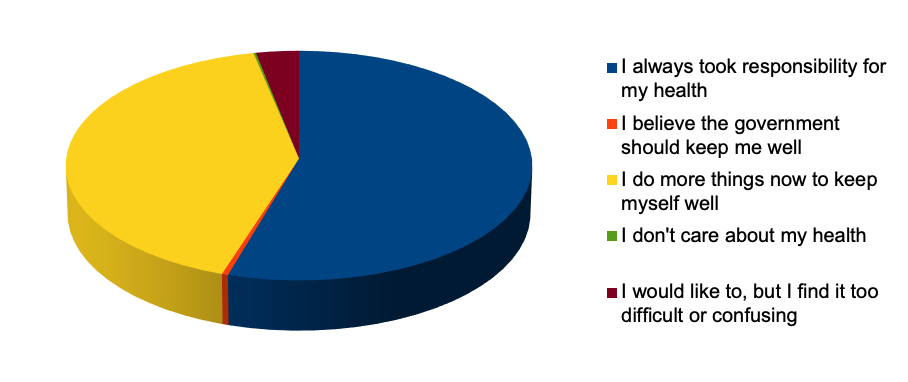
The majority of respondents (54.64%) state that they have always taken responsibility for their health, indicating that for many, the pandemic did not significantly alter their approach to personal well-being.
However, a substantial portion (41.63%) report that they now take a more active role in their health, suggesting that the pandemic era served as a wake-up call for many individuals to adopt healthier habits and proactive self-care measures.
Very few respondents believe that health should be the government’s responsibility (0.41%) or that they don’t care about their health (0.18%), indicating a strong sense of personal accountability among the majority.
A small group (3.14%) express a desire to take better care of themselves but find it too difficult or confusing, suggesting that accessibility to clear health guidance or motivation may be a barrier for some.
The results reflect a high level of personal responsibility when it comes to health, with most individuals either maintaining or increasing their proactive approach to well-being since the pandemic. Very few believe in relying on external systems for their health, reinforcing a broader trend of self-reliance and health-conscious decision-making.
Responses
I always took responsibility for my health = 54.64%
I believe the government should keep me well = 0.41%
I do more things now to keep myself well = 41.63%
I don’t care about my health = 0.18%
I would like to, but I find it too difficult or confusing = 3.14%